 Image 1 of 1
Smoke Control Systems: Design, Installation & Testing - A Comprehensive 8-Hour Training Program
ACTIVE AHJ’s, Use Promo Code FIREHERO for 50% discount
8 Hours | .08 CEU
Smoke control systems are among the most technically complex and coordination-intensive life safety systems in any building project — and the consequences of getting them wrong show up at the worst possible moment: final inspection, with the AHJ and special inspector watching.
This full-day virtual course cuts through that complexity by following a smoke control project from the first sales conversation to the last signature on the acceptance test report. Participants will develop a working understanding of the full ecosystem of responsibility — who designs it, who installs it, who tests it, who approves it, and how every one of those parties creates constraints for the others. The course addresses the real coordination failures that drive rework and failed tests, the code framework under IBC Section 909, NFPA 72, and NFPA 92, manufacturer-specific FSCS panel design parameters for EST, Siemens, Notifier, and GW/FCI platforms, and the complete acceptance testing framework required under IBC 909.
Delivered virtually in six structured sessions with built-in interaction, group exercises, and scenario-based discussion, this course is designed for fire alarm professionals, project managers, AHJs, fire inspectors, and anyone whose work touches a smoke control system from design through certification.
How the Format Benefits Attendees
This course is not a lecture. Every session is built around the reality that the professionals in the room already have field experience — and that experience is part of the curriculum.
Each of the six sessions opens with a framing question drawn from real project scenarios. Participants are prompted to engage not just as students, but as practitioners who have lived some version of what is being discussed. Structured group activities — stakeholder mapping exercises, coordination matrix analysis, backward scheduling from a test date, shop drawing review, and a high-stakes test-day scenario — require participants to apply content in real time rather than passively receive it.
Discussion prompts are embedded throughout the presentation and are designed to surface disagreement, not just consensus. When the question is "who owns resolution when the SOO changes during installation?", there is no clean textbook answer — and the conversation that follows is where the actual learning happens.
Because the course is delivered virtually, participants join from different companies, markets, and roles. That diversity is an asset. A participant from a large commercial fire alarm contractor and a participant from a small specialty firm will often describe the same coordination failure from entirely different vantage points — and both perspectives make the room smarter. The facilitator actively draws out those contrasts throughout the day.
How This Course Addresses Varied Perspectives
Smoke control is one of the few disciplines where a single project requires a licensed fire protection engineer, a mechanical contractor, an electrical contractor, a controls contractor, an air balancer, a special inspection agency, the AHJ, and the fire alarm installer to all agree on the same sequence of operations — and then prove it in front of witnesses.
This course is structured around that reality. Every major topic is examined from at least two stakeholder vantage points:
The fire alarm installer sees a smoke control project as an integration and programming challenge with significant coordination risk. The AHJ sees it as a code compliance and acceptance testing obligation with liability attached. The fire protection engineer sees it as a performance-based design problem with a rational analysis at its foundation. The project manager sees it as a schedule and cash flow problem disguised as a technical one.
This course presents all four of those perspectives — not as competing views, but as interdependent ones. Participants will hear how AHJs evaluate FSCS panel submittals, how FPEs expect their rational analysis to drive programming logic, and how the controls contractor's BAS integration decisions can make or break a test that the fire alarm installer is responsible for coordinating. Scenario-based activities place participants in the seat of different stakeholders, requiring them to reason through decisions the way someone else on the project would.
The result is a more complete picture of the project than any single discipline typically carries into the field.
Actionable Takeaways
Participants leave this course with tools they can use on their next project — not concepts to look up later:
A complete construction phasing timeline framework that maps every smoke control milestone from engineering through acceptance testing, with lead times built in for FSCS panel manufacturing, air balance, special inspector approval, and emergency power testing.
A pre-test readiness checklist covering all system components, documentation, and contractor coordination required before scheduling the AHJ witness — so that the final test confirms what is already known to work.
An FSCS design checklist covering 26 specific review items across all major manufacturer platforms, including listing category, switch and LED configuration, CBE table programming logic, graphic annunciator accuracy, and enclosure sizing.
A stakeholder coordination matrix identifying the specific interface risks between the fire alarm installer and each of the five primary disciplines — and the project phase in which each risk must be resolved.
A working knowledge of IBC Section 909.18 acceptance testing requirements and the documentation package required to achieve final certification — including air balance reports, duct leakage testing, door opening force measurements, emergency power confirmation, and special inspection reporting.
Learning Objectives
Upon successful completion of this course, participants will be able to:
Identify the five primary disciplines in the smoke control project ecosystem and articulate the specific coordination obligations of the fire alarm installer with each party, using the stakeholder matrix framework introduced in Session 1.
Explain how architectural, mechanical, and electrical design decisions — including device placement, fan scheduling, damper control wiring, and emergency power sequencing — directly constrain fire alarm system design and installation scope.
Interpret the key provisions of IBC Section 909, NFPA 72, NFPA 92, and UL 864 as they apply to the design, installation, and acceptance testing of engineered smoke control systems.
Apply a construction phasing framework to establish critical milestone dates for smoke control scope, including procurement, FSCS panel manufacturing, air balance completion, special inspector coordination, and pre-test readiness.
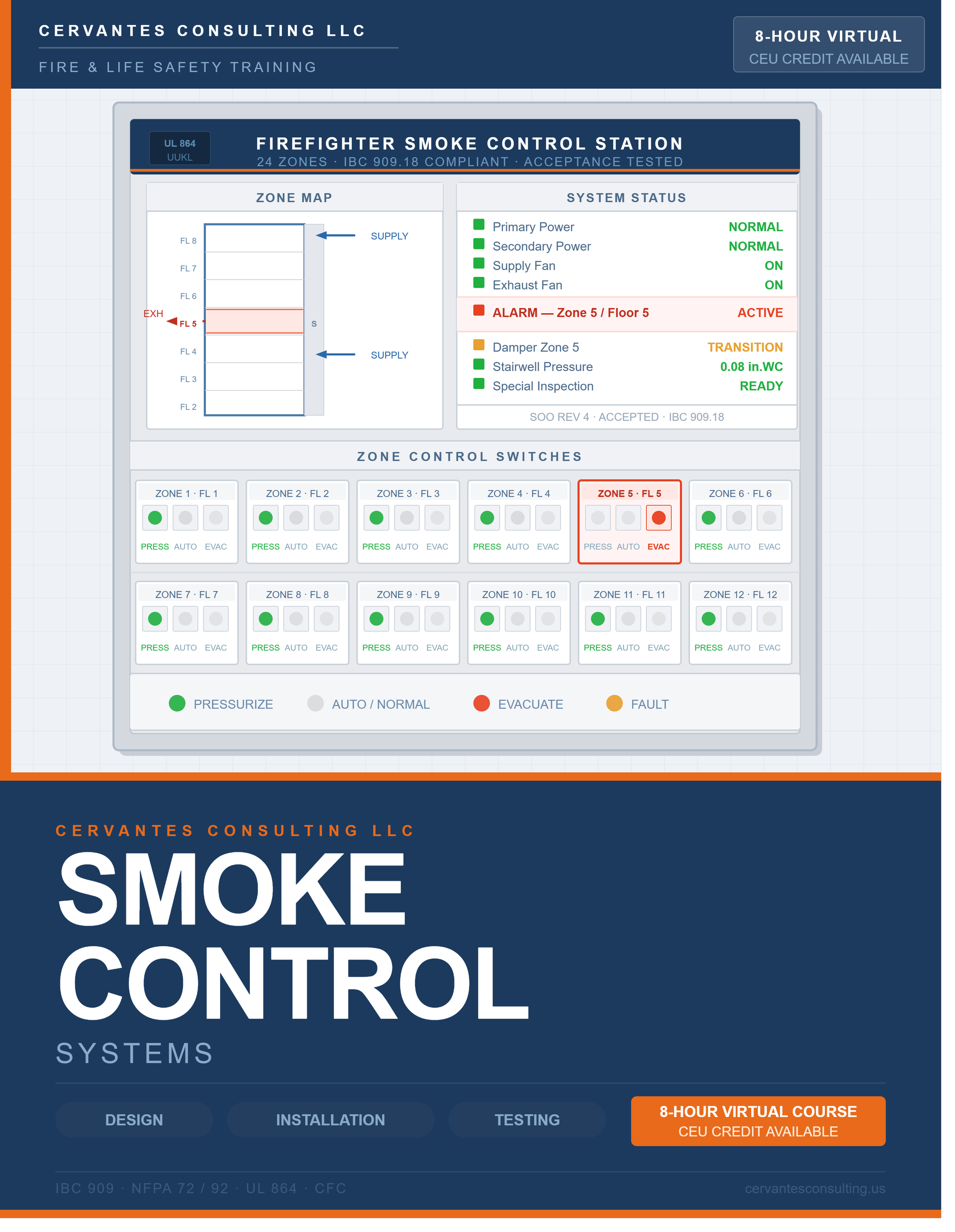
Evaluate Firefighter Smoke Control Station (FSCS) panel shop drawings against a 26-point design checklist, identifying deficiencies in listing category, switch/LED configuration, CBE table logic, and graphic annunciator accuracy across EST, Siemens, Notifier, and GW/FCI platforms.
Demonstrate the acceptance testing framework required under IBC 909.18 by completing a final testing documentation matrix that includes measured values, pass/fail criteria, and documentation responsibilities for all system components.
Analyze real-world coordination failure scenarios and identify the project phase, responsible party, and corrective action that would have prevented the failure — using scenario-based activities completed during the course.
ACTIVE AHJ’s, Use Promo Code FIREHERO for 50% discount
8 Hours | .08 CEU
Smoke control systems are among the most technically complex and coordination-intensive life safety systems in any building project — and the consequences of getting them wrong show up at the worst possible moment: final inspection, with the AHJ and special inspector watching.
This full-day virtual course cuts through that complexity by following a smoke control project from the first sales conversation to the last signature on the acceptance test report. Participants will develop a working understanding of the full ecosystem of responsibility — who designs it, who installs it, who tests it, who approves it, and how every one of those parties creates constraints for the others. The course addresses the real coordination failures that drive rework and failed tests, the code framework under IBC Section 909, NFPA 72, and NFPA 92, manufacturer-specific FSCS panel design parameters for EST, Siemens, Notifier, and GW/FCI platforms, and the complete acceptance testing framework required under IBC 909.
Delivered virtually in six structured sessions with built-in interaction, group exercises, and scenario-based discussion, this course is designed for fire alarm professionals, project managers, AHJs, fire inspectors, and anyone whose work touches a smoke control system from design through certification.
How the Format Benefits Attendees
This course is not a lecture. Every session is built around the reality that the professionals in the room already have field experience — and that experience is part of the curriculum.
Each of the six sessions opens with a framing question drawn from real project scenarios. Participants are prompted to engage not just as students, but as practitioners who have lived some version of what is being discussed. Structured group activities — stakeholder mapping exercises, coordination matrix analysis, backward scheduling from a test date, shop drawing review, and a high-stakes test-day scenario — require participants to apply content in real time rather than passively receive it.
Discussion prompts are embedded throughout the presentation and are designed to surface disagreement, not just consensus. When the question is "who owns resolution when the SOO changes during installation?", there is no clean textbook answer — and the conversation that follows is where the actual learning happens.
Because the course is delivered virtually, participants join from different companies, markets, and roles. That diversity is an asset. A participant from a large commercial fire alarm contractor and a participant from a small specialty firm will often describe the same coordination failure from entirely different vantage points — and both perspectives make the room smarter. The facilitator actively draws out those contrasts throughout the day.
How This Course Addresses Varied Perspectives
Smoke control is one of the few disciplines where a single project requires a licensed fire protection engineer, a mechanical contractor, an electrical contractor, a controls contractor, an air balancer, a special inspection agency, the AHJ, and the fire alarm installer to all agree on the same sequence of operations — and then prove it in front of witnesses.
This course is structured around that reality. Every major topic is examined from at least two stakeholder vantage points:
The fire alarm installer sees a smoke control project as an integration and programming challenge with significant coordination risk. The AHJ sees it as a code compliance and acceptance testing obligation with liability attached. The fire protection engineer sees it as a performance-based design problem with a rational analysis at its foundation. The project manager sees it as a schedule and cash flow problem disguised as a technical one.
This course presents all four of those perspectives — not as competing views, but as interdependent ones. Participants will hear how AHJs evaluate FSCS panel submittals, how FPEs expect their rational analysis to drive programming logic, and how the controls contractor's BAS integration decisions can make or break a test that the fire alarm installer is responsible for coordinating. Scenario-based activities place participants in the seat of different stakeholders, requiring them to reason through decisions the way someone else on the project would.
The result is a more complete picture of the project than any single discipline typically carries into the field.
Actionable Takeaways
Participants leave this course with tools they can use on their next project — not concepts to look up later:
A complete construction phasing timeline framework that maps every smoke control milestone from engineering through acceptance testing, with lead times built in for FSCS panel manufacturing, air balance, special inspector approval, and emergency power testing.
A pre-test readiness checklist covering all system components, documentation, and contractor coordination required before scheduling the AHJ witness — so that the final test confirms what is already known to work.
An FSCS design checklist covering 26 specific review items across all major manufacturer platforms, including listing category, switch and LED configuration, CBE table programming logic, graphic annunciator accuracy, and enclosure sizing.
A stakeholder coordination matrix identifying the specific interface risks between the fire alarm installer and each of the five primary disciplines — and the project phase in which each risk must be resolved.
A working knowledge of IBC Section 909.18 acceptance testing requirements and the documentation package required to achieve final certification — including air balance reports, duct leakage testing, door opening force measurements, emergency power confirmation, and special inspection reporting.
Learning Objectives
Upon successful completion of this course, participants will be able to:
Identify the five primary disciplines in the smoke control project ecosystem and articulate the specific coordination obligations of the fire alarm installer with each party, using the stakeholder matrix framework introduced in Session 1.
Explain how architectural, mechanical, and electrical design decisions — including device placement, fan scheduling, damper control wiring, and emergency power sequencing — directly constrain fire alarm system design and installation scope.
Interpret the key provisions of IBC Section 909, NFPA 72, NFPA 92, and UL 864 as they apply to the design, installation, and acceptance testing of engineered smoke control systems.
Apply a construction phasing framework to establish critical milestone dates for smoke control scope, including procurement, FSCS panel manufacturing, air balance completion, special inspector coordination, and pre-test readiness.
Evaluate Firefighter Smoke Control Station (FSCS) panel shop drawings against a 26-point design checklist, identifying deficiencies in listing category, switch/LED configuration, CBE table logic, and graphic annunciator accuracy across EST, Siemens, Notifier, and GW/FCI platforms.
Demonstrate the acceptance testing framework required under IBC 909.18 by completing a final testing documentation matrix that includes measured values, pass/fail criteria, and documentation responsibilities for all system components.
Analyze real-world coordination failure scenarios and identify the project phase, responsible party, and corrective action that would have prevented the failure — using scenario-based activities completed during the course.